
Rice Tillering Stage
Meaning, tiller formation, maximum tillering and the shoots that become grain-bearing panicles.
Tillering is the production of new shoots from basal axillary buds. Primary tillers arise from the main culm, secondary tillers arise from primary tillers, and the tillers that survive to bear panicles are called productive or effective tillers.

Tillering at a Glance
A tiller is a complete shoot with its own culm, leaves and roots—not merely a branch. Tillering begins after seedling establishment, rises through active and maximum tillering, and generally ends as the crop enters panicle initiation.


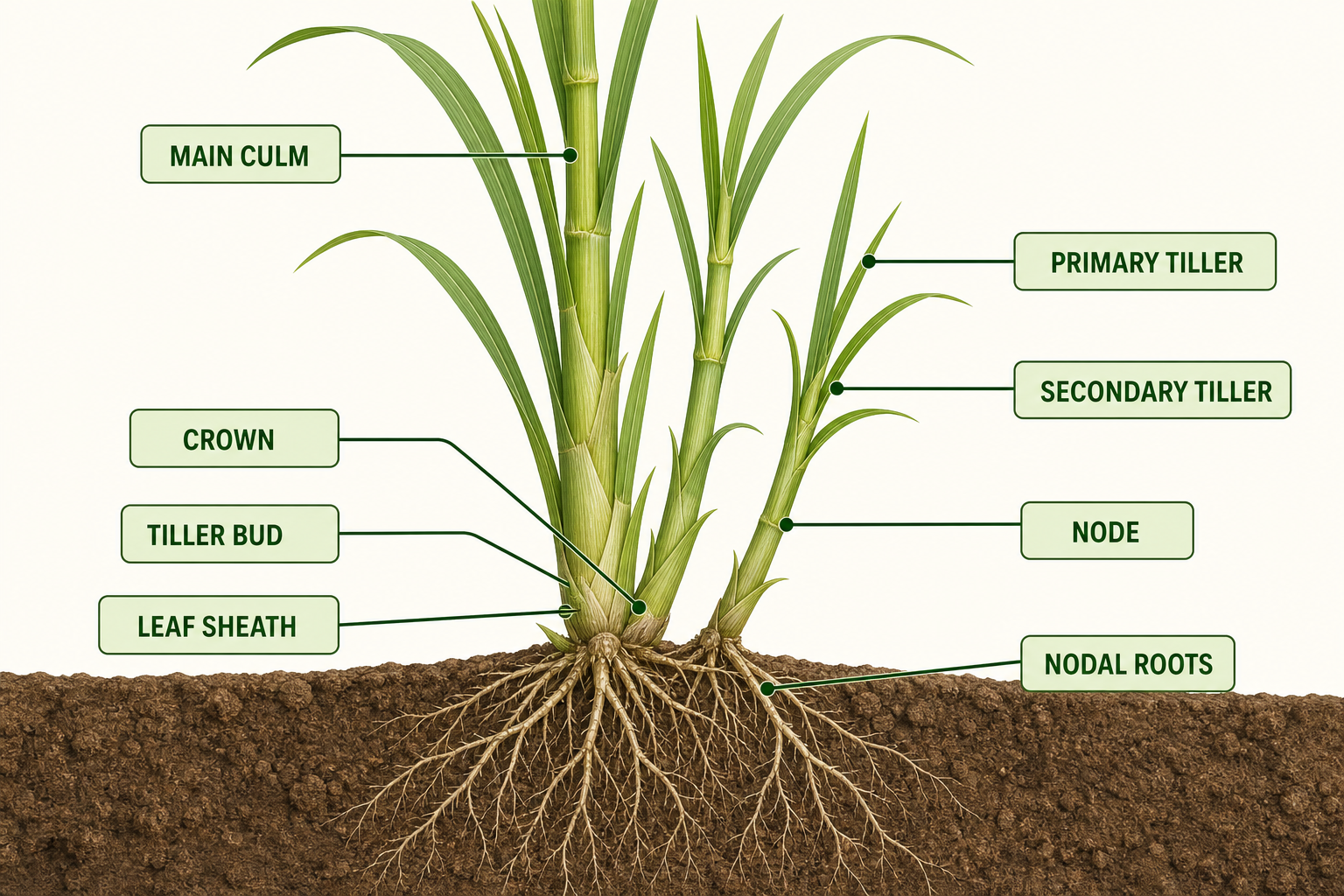
What Is Tillering in Rice?
Tillering increases shoot number after establishment. Each new tiller repeats the basic organization of the main shoot.
Main Culm
The original central shoot. Its lower nodes carry axillary buds that can produce primary tillers.
Start of the hierarchyTiller Bud
A basal axillary bud becomes active and grows through the surrounding leaf sheath.
Located at a leaf axilPrimary Tiller
A first-order shoot developing directly from a lower node of the main culm.
Arises from the main culmSecondary Tiller
A second-order shoot developing from a primary tiller. Tertiary tillers may also form.
Arises from a primary tillerNodal Roots
Tillers can produce their own roots while remaining attached at the plant crown.
Supports resource uptakeComplete Shoot
A tiller includes a culm, leaves, growing point and roots. A culm is only the stem within that shoot.
Tiller ≠ culmHow Rice Tillers Form
The hierarchy expands through successive orders. Only tillers that survive and bear panicles contribute directly to final panicle number.
The Developmental Hierarchy
From the original seedling shoot to the later grain-bearing tillers.
The original seedling shoot
Arises from the main culm
Arises from a primary tiller
Peak living shoot count
Survives and bears a panicle

From First Tiller to Panicle Initiation
Timing varies with variety, establishment method and environment. Use leaf development and crop condition rather than one universal day number.
Seedling Establishment
The main shoot develops leaves and a functioning root system.
Seedling guide →First Tiller
Rice commonly begins tillering at about the five-leaf stage, although timing varies.
Identify leaves →Active Tillering
Primary and secondary tillers emerge while shoot number rises rapidly.
Management tips →Maximum Tillering
The crop reaches its highest tiller count; some weak shoots may later die.
Field checks →Effective Tillering
Stronger tillers persist as the crop approaches reproductive development.
Compare tillers →Productive vs Non-Productive Tillers
Peak tiller count and final panicle-bearing tiller count are not the same.
Productive / Effective
Survives into reproduction, bears a panicle and contributes directly to panicle number.
Non-Productive
Dies, remains weak, or fails to produce a panicle. Late tillers are often at greater risk.
Why Counts Differ
Competition, shading, stress and late emergence can reduce survival after maximum tillering.
Factors That Affect Rice Tillering
Tiller number reflects genetic potential interacting with stand density, resources and crop stress.
Variety & Duration
Genetics influence tillering capacity and timing.
Spacing & Stand
Population changes competition and tillers per hill.
Light
Strong shading can restrict bud growth and survival.
Nutrient Supply
Balanced nutrition supports sturdy shoot growth.
Water & Soil
Root-zone conditions affect shoot production.
Stress & Competition
Weeds, pests, disease and temperature can suppress tillering.
Interpret carefully: More tillers per hill do not automatically mean higher yield. Productive tillers per area and the other yield components matter more.
Management Priorities During Tillering
Support a uniform stand and healthy shoots without forcing excessive, weak growth.
| Priority | Observe | Response | Why it matters |
|---|---|---|---|
| Stand uniformity | Missing hills and weak patches | Correct gaps early where locally advised | Reduces uneven competition |
| Weed competition | Weeds within and between rows | Control during the locally defined critical period | Protects light, nutrients and space |
| Nutrient status | Leaf colour, growth and soil tests | Follow balanced local recommendations | Supports sturdy shoots |
| Water condition | Root-zone moisture and stress | Use the regime suited to system and soil | Protects roots and new growth |
| Crop health | Damage, dead hearts and symptoms | Identify the cause before treatment | Prevents tiller loss |
Local guidance matters: Fertilizer, irrigation and plant density vary by variety, soil, climate and establishment method. Use extension and soil-test recommendations for rates and dates.
Signs of Healthy Tillering
- New shoots emerge from the basal region.
- Plants develop sturdy green shoots.
- The stand remains reasonably uniform.
- New tillers develop leaves and nodal roots.
- Growth is not suppressed by weeds or stress.
Common Tillering Problems
- Poor establishment leaves too few plants.
- Dense stands produce weak, shaded tillers.
- Weed competition suppresses shoots.
- Nutrient, water or temperature stress slows growth.
- Late tillers may remain non-productive.
Rice Tillering Terms at a Glance
| Term | Meaning | Field interpretation | Timing |
|---|---|---|---|
| Tiller | Complete lateral shoot with culm, leaves and roots | Count shoots, not leaves | Vegetative phase |
| Primary tiller | Develops from the main culm | First order | After establishment |
| Secondary tiller | Develops from a primary tiller | Second order | Active tillering |
| Maximum tillering | Peak number of living tillers | Some may still die | Before reproduction |
| Productive tiller | Survives and bears a panicle | Adds a panicle | Confirmed later |
| Non-productive tiller | Does not bear a panicle | No harvestable panicle | Recognized later |
Explore the Next Rice Topics
Connect tiller formation with anatomy, management and the reproductive stages that follow.
Questions About Rice Tillering
Direct answers to the meanings, timing and field observations users search for most often.
What is tillering in rice?
Tillering is the formation of lateral shoots from basal axillary buds. Each tiller can develop a culm, leaves and roots.
When does tillering start in rice?
IRRI references describe tillering as beginning when the seedling has about five leaves and is self-supporting. Calendar days vary.
What is maximum tillering?
It is the point at which the plant or stand has its highest number of living tillers. Final panicle-bearing tiller number is usually lower.
What is the difference between primary and secondary tillers?
Primary tillers arise from the main culm. Secondary tillers arise from primary tillers.
What is a productive tiller?
A productive or effective tiller survives into reproduction and bears a panicle.
How many tillers should a rice plant have?
There is no universal ideal. Variety, spacing, establishment system and target population change the useful count.
Does more tillering always increase rice yield?
No. Productive tillers and the other yield components matter more than peak shoot count alone.
When does tillering end?
Tillering generally declines as the crop approaches panicle initiation and shifts to reproductive development.
Built from trusted rice-development references
The shoot hierarchy, five-leaf timing, root relationship and transition toward panicle initiation follow IRRI resources.