
Parts of a Rice Plant
Labeled anatomy, scientific structure and the function of every major plant part.
A rice plant is a tillering cereal grass composed of a fibrous root system, a crown, jointed culms, leaves and a terminal branched panicle. These structures work together to support establishment, photosynthesis, flowering and grain production.

Rice Plant at a Glance
The rice plant has underground vegetative structures, above-ground vegetative structures and reproductive structures. Roots absorb water and nutrients; the crown produces tillers; culms support and transport resources; leaves capture light; and panicles bear spikelets that develop into rice grain.

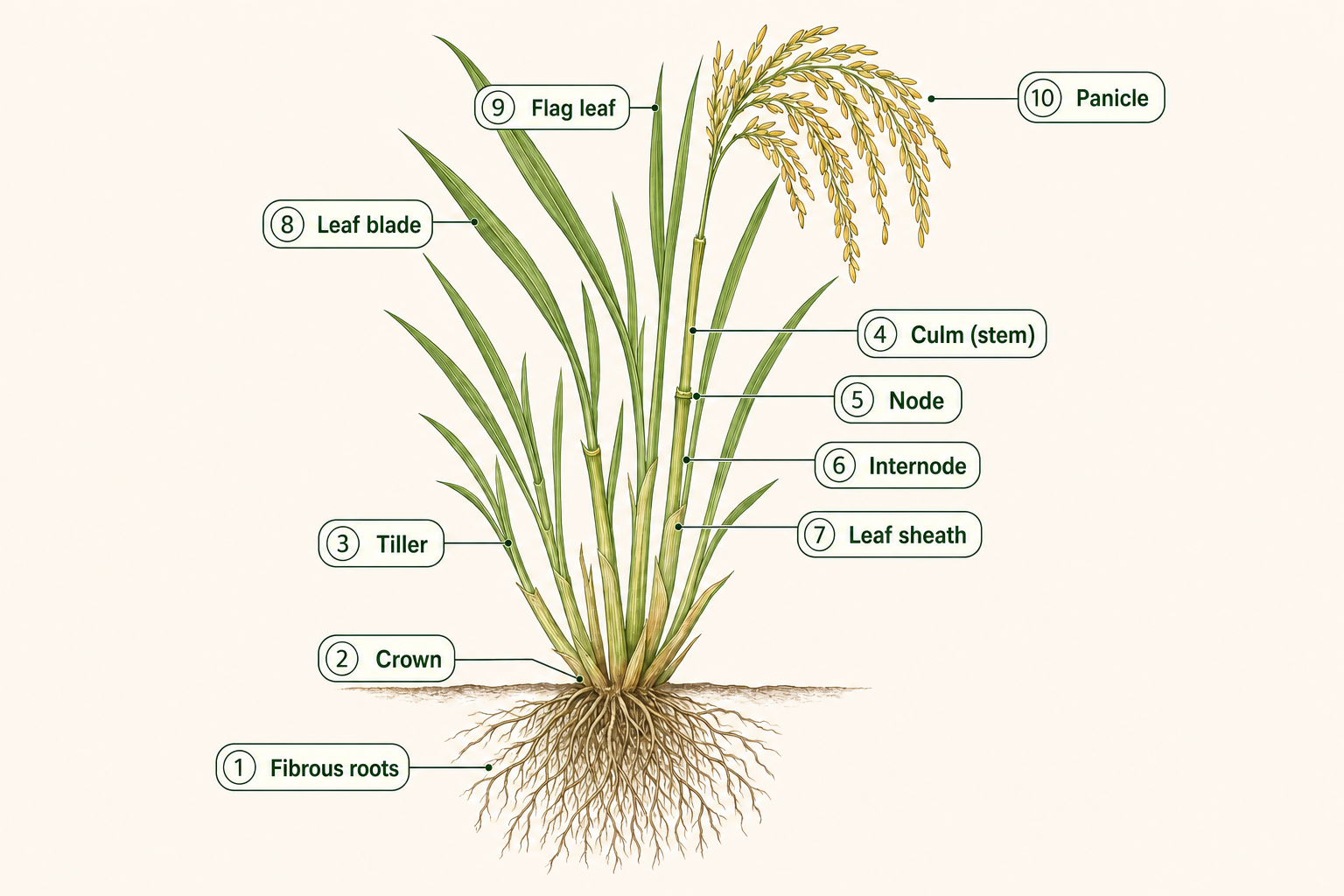
Main Parts at a Glance
The rice plant is best understood as an interconnected system rather than a collection of isolated organs.
Roots
Anchor the plant and absorb water and mineral nutrients.
Crown
The basal growth region from which tillers and nodal roots arise.
Tillers
Secondary shoots capable of forming their own leaves and panicles.
Culm
The jointed stem that supports leaves and the terminal panicle.
Leaves
Blade-and-sheath structures that perform most photosynthesis.
Panicle
The branched terminal inflorescence bearing rice spikelets.
Spikelet
The reproductive unit containing the floret.
Grain
The mature caryopsis that stores starch and contains the embryo.
Structures That Build the Plant
Vegetative organs establish the crop, intercept light and supply the reproductive structures that ultimately form grain.

Fibrous Root System
Seminal roots support early establishment, while nodal or adventitious roots become the mature plant’s principal root system.
- Anchorage
- Water and nutrient absorption
- Aerenchyma-assisted internal aeration

Crown and Tillers
The crown is the compact basal region that produces nodal roots and new shoots. Tillers that form mature panicles are called productive tillers.
- Basal shoot formation
- Canopy expansion
- Panicle-number development

Culm, Nodes and Internodes
The rice stem is a jointed culm. Solid nodes separate the internodes and provide attachment points for leaves and tillers.
- Structural support
- Internal transport
- Panicle elevation

Leaves and Flag Leaf
Each leaf includes a sheath and blade, joined near the collar, ligule and auricles. The flag leaf is the uppermost leaf below the panicle.
- Photosynthesis
- Transpiration
- Gas exchange
Structures That Produce Grain
Rice reproduction progresses from a branched panicle to flowering spikelets and finally to mature caryopses.

Panicle
The panicle is the terminal branched inflorescence of rice. It includes the panicle base, main axis, primary and secondary branches, pedicels and spikelets.
Explore Rice Panicle Structure →
Spikelet and Flower
The spikelet includes sterile lemmas, a short rachilla and a floret enclosed by lemma and palea. The flower contains six stamens, lodicules and a pistil.
Explore Rice Flower Structure →
Rice Grain
Botanically, rice grain is a caryopsis. The hull encloses the bran-covered kernel, starchy endosperm and embryo or germ.
Explore Rice Grain Structure →
From Flower to Grain
After pollination and fertilization, the ovary develops into a grain while stored carbohydrates accumulate during grain filling.
Explore Rice Grain Development →How the Parts Work Together
No single structure is independently “most important.” Grain formation depends on coordinated vegetative and reproductive function.
When Each Plant Part Develops
Rice structures appear in a predictable sequence from germination to physiological maturity.
| Growth period | Structures developing | Biological focus |
|---|---|---|
| Germination | Seminal root, radicle and emerging shoot | Establishment |
| Seedling | Nodal roots, early culm and first leaves | Root and leaf expansion |
| Tillering | Crown, additional shoots and expanding roots | Potential panicle number |
| Stem elongation | Nodes, internodes and upper leaves | Canopy and panicle support |
| Reproductive phase | Panicle branches and spikelets | Yield-component formation |
| Flowering | Stamens, pistil and fertilized ovary | Pollination and fertilization |
| Grain filling | Endosperm and embryo | Starch and dry-matter accumulation |
| Maturity | Hardened grain and drying tissues | Harvest readiness |
Adaptations to Wet Conditions
- Air spaces known as aerenchyma help internal oxygen movement.
- Nodal roots become the principal mature root system.
- Leaf sheaths enclose and protect the culm.
- Tillering produces multiple potentially grain-bearing shoots.
- Not all rice is flooded; upland and rainfed systems also exist.
Common Anatomy Confusions
- A rice panicle is branched; a wheat spike is not the same structure.
- A tiller is an entire shoot; a culm is the stem within that shoot.
- The harvested rice grain is botanically a caryopsis.
- The hull is formed by lemma and palea around the mature kernel.
- Rice has a fibrous system, not a taproot.
Rice Plant Anatomy at a Glance
| Part | Location | Key feature | Main role |
|---|---|---|---|
| Roots | Below ground | Fibrous and predominantly nodal | Absorption and anchorage |
| Crown | Near soil surface | Compact basal growth region | Produces roots and tillers |
| Culm | Above ground | Nodes and internodes | Support and transport |
| Leaves | Attached at culm nodes | Blade and enclosing sheath | Photosynthesis and gas exchange |
| Panicle | Terminal culm | Branched inflorescence | Bears spikelets |
| Spikelet | Panicle branches | Contains one fertile floret | Flowering and fertilization |
| Grain | Within lemma and palea | Mature caryopsis | Storage and reproduction |
Explore Rice Anatomy in Detail
Move from the whole plant into the specialized structures that determine establishment, growth and yield.
Questions About Rice Plant Parts
Quick answers to common botanical and crop-science questions.
What are the main parts of a rice plant?
The principal parts are the fibrous roots, crown, tillers, jointed culms, leaves, panicles, spikelets and grains.
What is the stem of a rice plant called?
The stem is called a culm. It consists of nodes separated by internodes and supports the leaves and terminal panicle.
What is the difference between a tiller and a culm?
A tiller is a complete shoot arising near the plant base. The culm is the stem portion of that shoot.
Is rice grain a fruit or a seed?
Botanically, rice grain is a caryopsis—a dry, one-seeded fruit in which the fruit wall is closely fused with the seed coat.
What is the flag leaf?
The flag leaf is the uppermost leaf immediately below the panicle. It is an important photosynthetic source during grain filling.
Why can rice roots function in flooded soil?
Rice tissues contain interconnected air spaces called aerenchyma, which help move oxygen from above-ground tissues toward submerged organs.
What is the difference between a panicle and a spike?
A panicle is a branched inflorescence, while a spike bears sessile spikelets along an unbranched main axis. Rice produces a panicle; wheat produces a spike.
Built from trusted rice-science references
Terminology and structural descriptions are cross-checked against institutional rice morphology publications.